The Lost Love Letters of George ‘Beau’ Brummell, 1816
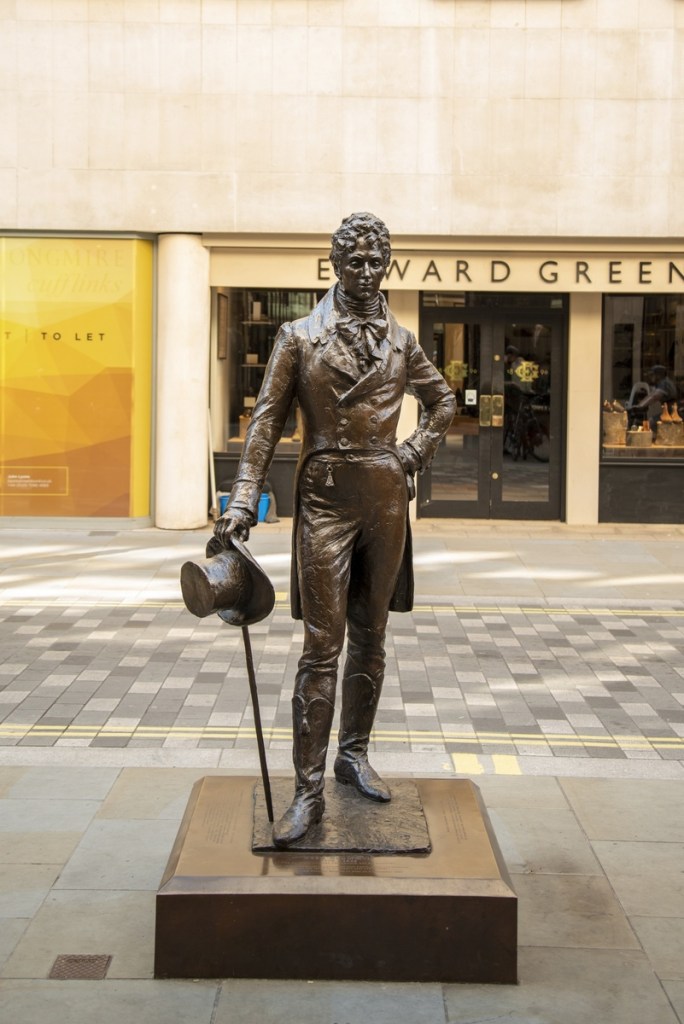
A few days before Christmas, as I perused the district of fashionable London; Bond Street, Burlington Arcade, and the irrepressible Savile Row – to marvel at window dressing and twinkling lights, not to double my mortgage on tailoring FYI – I found myself before the small and diminutive bronze statue of George ‘Beau’ Brummell, the archetypical fashionista who made, or more likely embodied, London, the male fashion capital of the world.
That I had left Savile Row just minutes before, running into Brummell’s effigy at the junction of Piccadilly Arcade and Jermyn Street brought back to mind a collection of letters I found in the Warwickshire County Records Office during the weird years of COVID-19 when we were permitted just an hour a week to request and observe documents, and then forgot about during the weird years of COVID-19 when we were permitted just an hour a week to request and observe documents. The letters were written in the hands of Brummell addressed to, among others, ‘Lady Sarah Savile’.[i]
Though ‘Sarah Savile’ has no connection to Savile Row, a pure coincidence of names it seems, the Brummell/Savile letters are a fascinating collection of letters, and letters that appear to have been overlooked, or more likely unknown, by historians of both Brummell and the early nineteenth century.
Here, then, is a short account of both the two protagonists, what the letters reveal, and how they relate to the wider picture of Brummell and his love life.
George ‘Beau’ Brummell to 1816
George Bryan Brummell (1778-1840) was born in Downing St, London, son of a successful political aide to Frederick lord North, Prime Minister of Great Britain between 1770 and 1782. His father’s profitable career and dynastic ambitions earned Brummell a fine education at Eton College and Oriel College, Oxford, where he combined lessons in Latin and history with the airs and graces of his elite classmates. He was said to have perfected the art of the ‘cut’, an English public school trait to ignore people though conscious of their presence; a way of demonstrating superiority and self-importance.[ii]
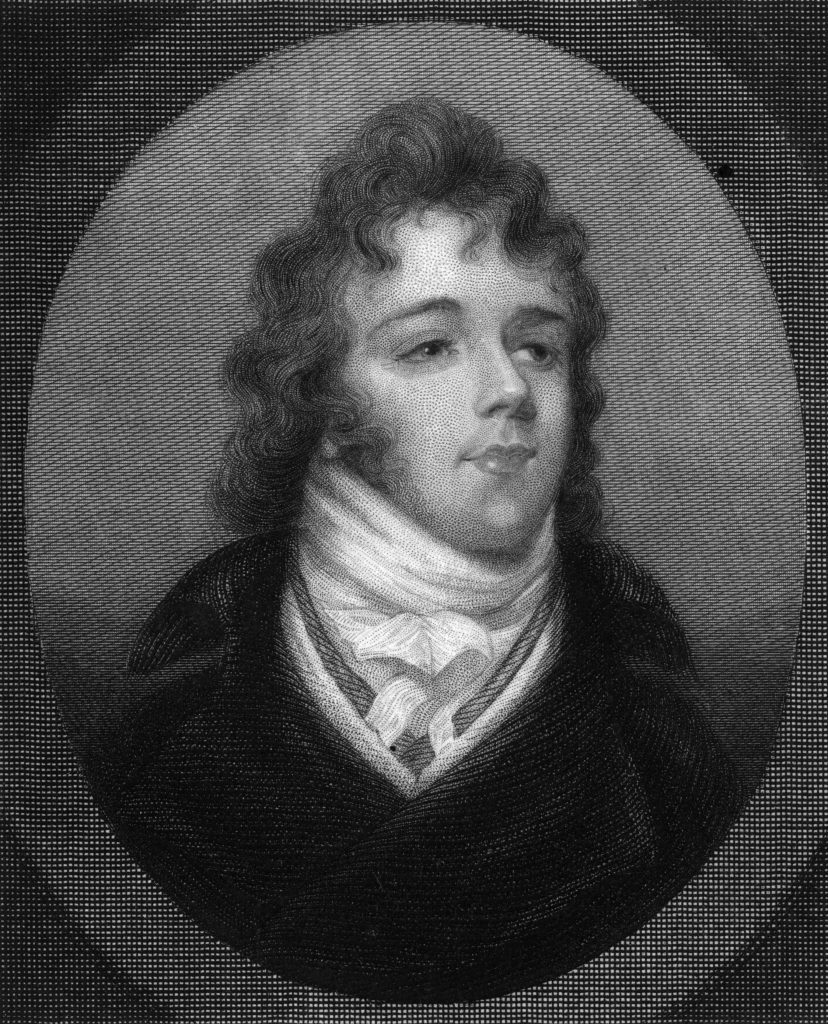
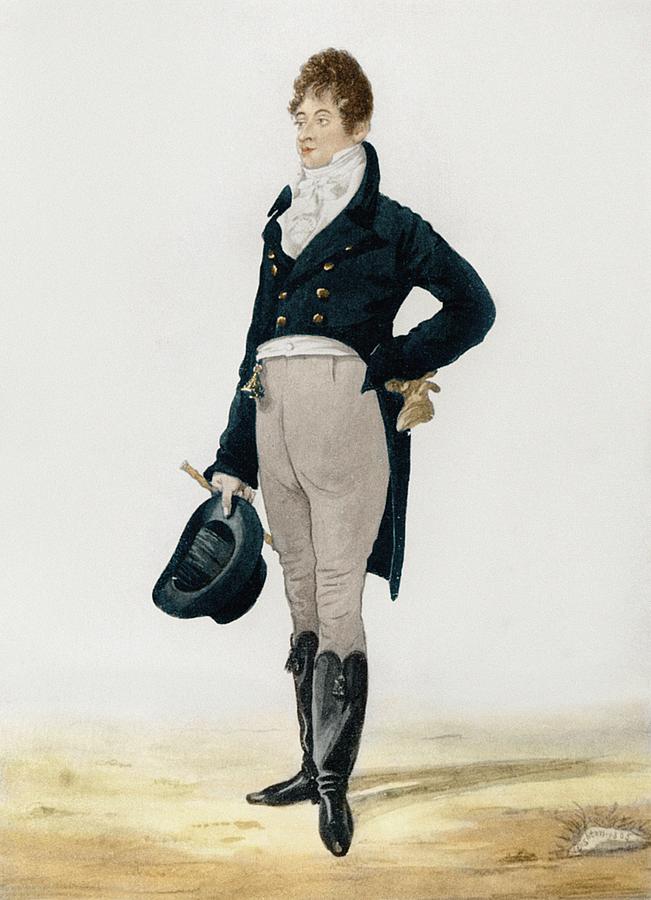
The ‘bank of Dad’ gave Brummell licence to tour the great Society balls of late eighteenth century London. He was particularly popular in Whig circles, and from May 1794 was a favoured companion of George prince of Wales. Together, Brummell and the prince transformed the court dress and established etiquette of the court, rejecting the fashion for magnificent and excessive clothing. He is often known as the harbinger of ‘Dandyism’, a style of independence, capriciousness and simple tailoring, coupled with imperious and impolite manners. His trademark look, a blue coat, white waistcoat, trim black pants buttoned to the ankle, and highly starched cravat that forced the chin to lift giving the airs of superiority (i.e. to look down the nose at someone) was a wild and successful sensation in the early years of Regency court life. He was snobbish, competitive, rude, and self-righteous, yet charming and witty, attributes that overtime would become the hallmark of aristocratic dandyism.
Ian Kelly’s marvellous biography of Brummell, Beau Brummell: The Ultimate Dandy (2005), outlines Brummell’s sordid and mischievous romantic and sexual life. Throughout his life, he seemed to hold onto his schoolboy instincts when it came to women. As an attractive, popular man with a persona of overly-stated masculinity, Brummell naturally courted attention, but he often returned affections that were both passionate and distant. He would make repeated offers of engagement to young women at court, often in order to climb into their beds, only to reveal it was a trick played for his own vanity, the amusement of friends, or sometimes with a misplaced sense of courtesy: he occasionally told women that his offer of engagement was merely a compliment, not an official offer. He also once claimed he could not marry a ‘Lady Mary’ because he discovered she ate cabbage.
In modern lingo, Brummell might be understood as a ‘f*ck boy’, a man who liberally played with women’s emotions for his own gratification and the amusement of the ‘lads’. He was a frequent forgoer of West End brothels, and may have been bisexual too, and even had the verve to offer professional courtesans lessons in sexual intercourse. Needless to say, by 1816 Brummell had contracted syphilis from his bachelor adventures.
It was the least of troubles, though. By 1816, Brummell was on the precipice of social exclusion. He had already lost his friendship with the Prince Regent, who had cooled to Brummell’s constant mockery; the final fallout famously occurring when Brummell once asked the Prince’s companion: ‘who’s your fat friend?’
Worse was to follow when Brummell’s inheritance ran dry, and his efforts to recover his fortune through gaming and betting of the races failed. He was sunk by at least £30,000, and most likely far more. His reputation was sunk in early 1816 when one of his debtors Richard Meyler called Brumell out at White’s Club, informing every member of Brummell’s inability to pay his debt and, in shocking behaviour, to have breached a gentleman’s agreement.
He was ruined, and on 16 May 1816, when London was distracted by the engagement of Princess Charlotte to Prince Leopold of Saxe-Gotha, he slipped out of the city, boarded a boat, and escaped to France. He never returned to England again.
Sarah lady Monson to 1816
Sarah Savile (1786-1851) was the eldest daughter of the Anglo-Irish peer John Savile, earl of Mexborough. Born at Methley Park in Yorkshire, Sarah was nonetheless a fixture of the London court circles as the Mexborough’s aspired for greater political advancement. In 1807, when she was twenty-one, she married John lord Monson, a Tory-supporting landowner from Lincolnshire. Politics clearly mattered in their marriage settlement; Sarah’s father the earl of Mexborough would actually stand as a Tory MP in Lincoln when it looked like the family might lose their seat. Though undoubtedly an arranged affair, throughout her life Sarah would often look back with love and affection on her first husband, and she would feel more at home at his country estate Gatton Park than anywhere else. After siring a young son to lord Monson, Sarah was widowed after just two years in 1809.
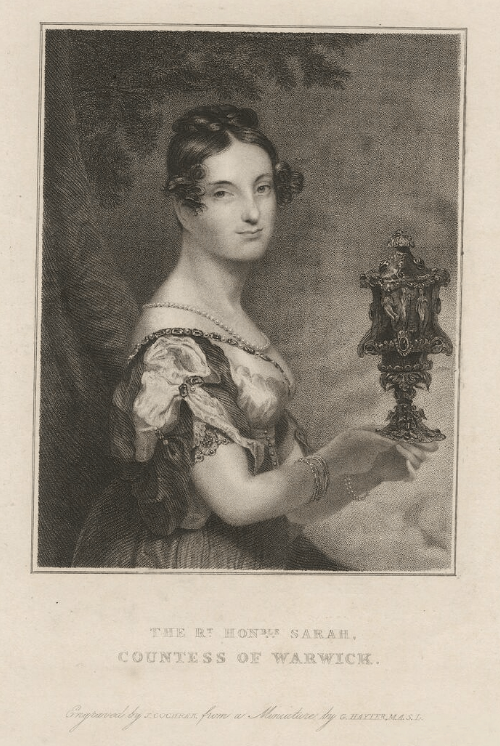
It was here, aged twenty-three, that some of Sarah’s personality begins to form through her archival papers. Young Sarah was a woman of the Georgian court, a consummate gossiper, ‘naturally witty’ without intelligence as one later observer commented, combining a sweet temper with uncontrolled outbursts when threatened or insulted.[iii] She clearly took her nobility and background seriously; in one letter to Georgiana, Marchioness of Worcester in 1814, Sarah wrote:
“I was a great friend of yours formerly, but now because you are a marchioness you seem to think you cannot give yourself enough airs, when you were little Miss FitzRoy, you were grateful to anybody that noticed you, you now ape Lady Jersey in everything, you can never be like her: in figure, beauty, fashion, or anything else remember she is noble by birth, you by marriage, a wide difference.
Your present pride that you affect, is quite a thing to be quizzed, and laughed at, a little plain body like you, pretending to be the pink of fashion, you have this year lost all your beauty, you are a ragged squirm, ugly little thing, all pouts and angles, your nose, and chin like the picture of skin and grease.
Brag in moderation, may impose upon the public, but plastered as you now do your face, it won’t do.
Although I am severe, I am still your old friend and good wishes,
S Mexborough
Don’t cut your old acquaintances because Lady Jersey does, bad taste.
I shall see you tonight at Lady Heatherley’s – your husband is a very fine creature“[iv]
Her husband’s sizeable dowry and stewardship of the Monson lands, which could not be inherited by her son for another twenty years, made her an attractive proposition to male suitors. The Warwick archive contains a series of letters written by her suitors, and even more letters written by her female friends advising her who to consider, and who not to.
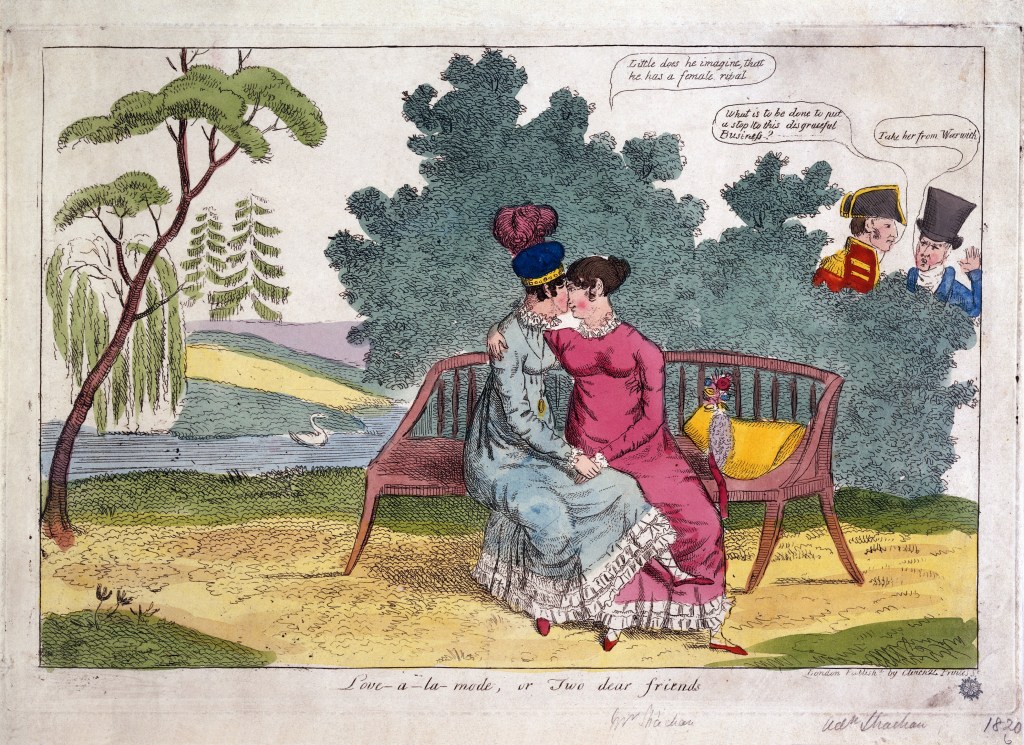
Sarah’s own sexuality is open to question, too. In 1820, a large satirical poster was plastered across a printmaker’s shop in Piccadilly called ‘Love-a-la-Mode’, depicting Sarah shawled in a blushing burgundy gown locking lips with Louise lady Strachan, wife of a famous Admiral; their future husbands peering over laurel bushes in the background.
It is debatable whether the print represents an accurate show of bisexuality or homosexuality on Sarah’s part (not that these terms would have made sense to her!), or they were humorous jokes on their husbands, who were both known to acquiesce to their partners’ ‘freedom and independence’. That being said, Sarah shared several intimate letters with female companions, including a Jane Blanchford who may have been the same Jane who belonged to the circles of Jane Austen on the Isle of Wight, who were rumoured to engage in same-sex encounters.
There was also Sarah’s future live-in companion, Caroline Neeld, a friend whom Sarah had taken in from her abusive husband and lived with her at Warwick Castle and Gatton Park from the 1830s to 1850s, but there were widespread rumours the two women were lovers; her later son George Greville had to delay his own marriage to Anne Charteris because Anne’s parents were unsettled by their closeness. More on that another time!
Beau Brummell and Sarah Monson: love letters in 1816
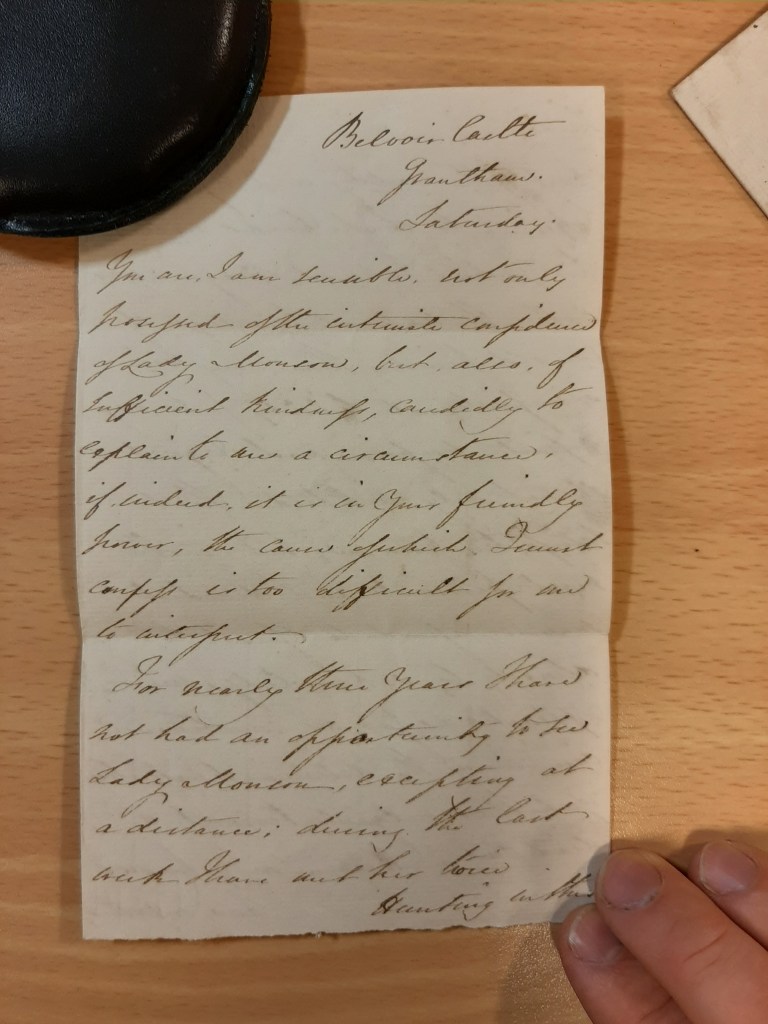
The collection of six letters written by Beau Brummell seemingly date from the winter/sprint of 1816, possibly some slightly earlier. The letters are not only sent directly to Sarah Monson but to one her close confidants Cecilia Foley of Witley Abbey, with the intention of being seen by (and then duly sent to) Sarah.
The letters reveal the following narrative story. At some point, presumably before 1808 when she was but a bachelor at court, Sarah may have been a victim of one of Brummell’s cruel ‘engagements.’ Brummell appears to have pursued Sarah like many other young women with passion and excitement, only to grow immediately distant and cold. Brummell would blame this on Sarah’s mother, whom he claims had ordered him to break off communication with Sarah, though the evidence of his other conquests render that unlikely.
Years later, and presumably around 1815 or 1816, Brummell attempted to revive his ‘engagement’ with Sarah. It was likely they met at a court ball, since she refused his offer to shake hands and refused to speak with him. Without Sarah’s responses, the nature of their exchange letters can only be gaged from Brummell.
First appealing for the intersession of her friends, Cecilia Foley for example, Sarah appears to have brushed off Brummell’s advances, reminding him she had a ‘thousand reasons’ why he would never be more than her friend. The nature of Brummell’s gambling debts appear to have played a part in her rejection of him, at least in Brummell’s mind. In truth, finances may have been the principal motivation for Brummell’s efforts to reopen his engagement with Sarah; her late husband’s inheritance would have been a useful boon to pay off his mounting debts.
The last letter Sarah receives was on Wednesday 15 May 1816, the day before he escaped London for France. Brummell’s letters conform to the same charming, romantic, poetic, self-righteous and rude character he had possessed for most of his life. Rather than offering a brand new interpretation of the Beau Brummell Ian Kelly and other biographers have painted, these letters confirm the picture of him being a fascinating, alluring shyster in his last dark, fateful days in London, making one final chase for a young woman’s attention, and her chequebook.
_____________________________________________________________
[i] The letters are loose and uncatalogued in WCRO/CR1886/Box 619
[ii] P. Carter, ‘Brummell, George Bryan [known as Beau Brummell’, Oxford DNB
[iii] Memoirs of the Duchesse de Dino, 1831-1835, ed. The Princesse Radziwill, (London, 1909), p29
[iv] WCRO/CR1886/Box 619
The Brummell Letters Transcripts
George Brummell to Lady Foley, Monday Evening
I must as usual appeal to your good nature and charity to forgive my writing to you. I am really very unhappy in the thought that I may have injured a most amiable friend of yours to seem unjust express for my inadvertent conduct this morning.
I saw the carriage waiting at your door in my unfortunate way through Berkley Square, and as the most trivial promise of opportunity is not to be neglected, I entered upon twenty convenient souls in Hill that, whose very existence was never before interesting, for the purpose of retaining that fatal carriage in my sight, when I perceived that she left your house alone, and God knows, suspecting little danger to be concealed behind Lady Essex’s opposite curtains, my improvident genius persuaded me immediately to advance, and I fear my sincerity was observed by the only person in the world whose friendly glare it is always my endeavour to [meet?] under such embarrassing circumstances.
I beseech you to assure her of my sorrow and contrition, if my precipitate attempt to speak to her was the cause of any after ansaid, tell her too, to forget that concern and also my imprudence which produced it, for, if I could for a moment imagine that either had made any formidable impressions, I should be the more unhappy.
Who could have expected Lady Essex’s door window to contain anything worth a servant’s regard?
I cannot express to you how happy I shall be to find you perfectly well upon my return from Belvoir. I am going tomorrow morning, and stay till Saturday; and do not judge my good wishes to be merely the insult of self-interest, though I must confess my earnest solicitude to speak to you upon a subject which in affectionate appreciation to “a though reasons” is still constantly […] in my mind.
George Brummell to Lady Cecilla Foley of Witley Abbey [from Belvoir Castle], Saturday
You are, I am sensible, not only possessed of the intimate confidence of Lady Monson, but, also of sufficient kindness, candidly to explain to me a circumstance, if indeed, it is in your friendly power, the cause of which I must confess is too difficult for me to interpret.
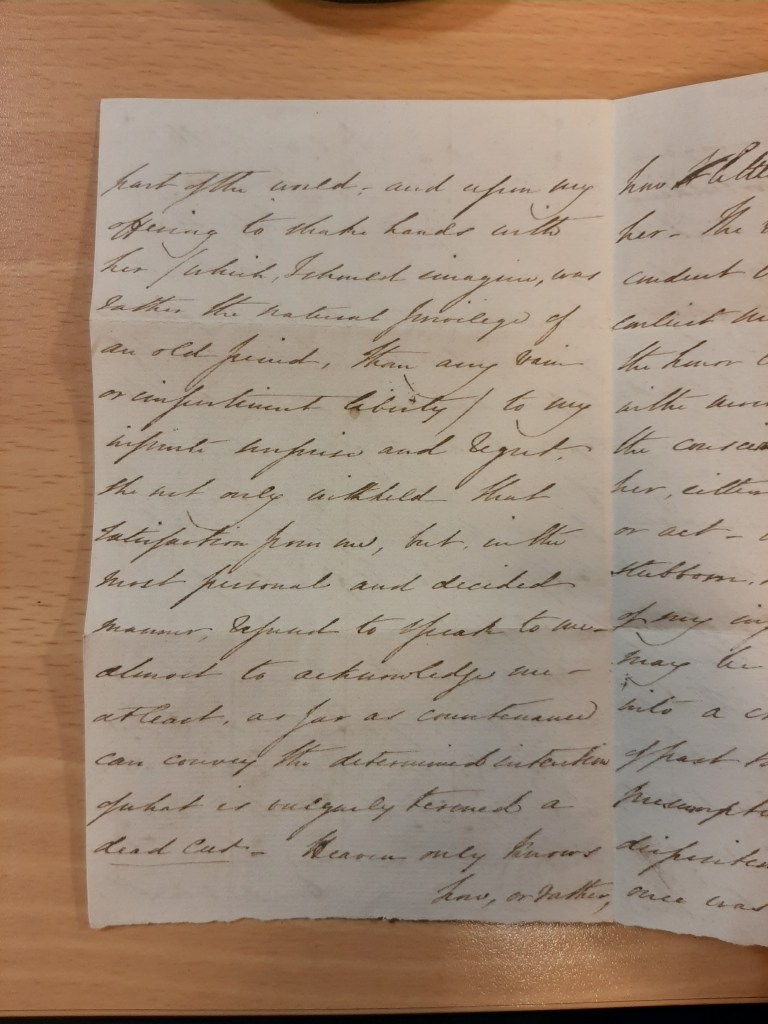
For nearly three years I have not had an opportunity to see Lady Monson, excepting at a distance, during the last week I have meet twice. Hunting in this part of the world, and upon my offering to shake hands with her (which I should imagine was rather the natural privilege of an old friend, than any vain or impertinent liberty) to my infinite surprise and regret she not only withheld that satisfaction from me, but, in the most personal and decided manner, refused to speak to me – almost to acknowledge me – at least, as far as countenance can convey the determined intention of what is vulgarly termed a dead cat.
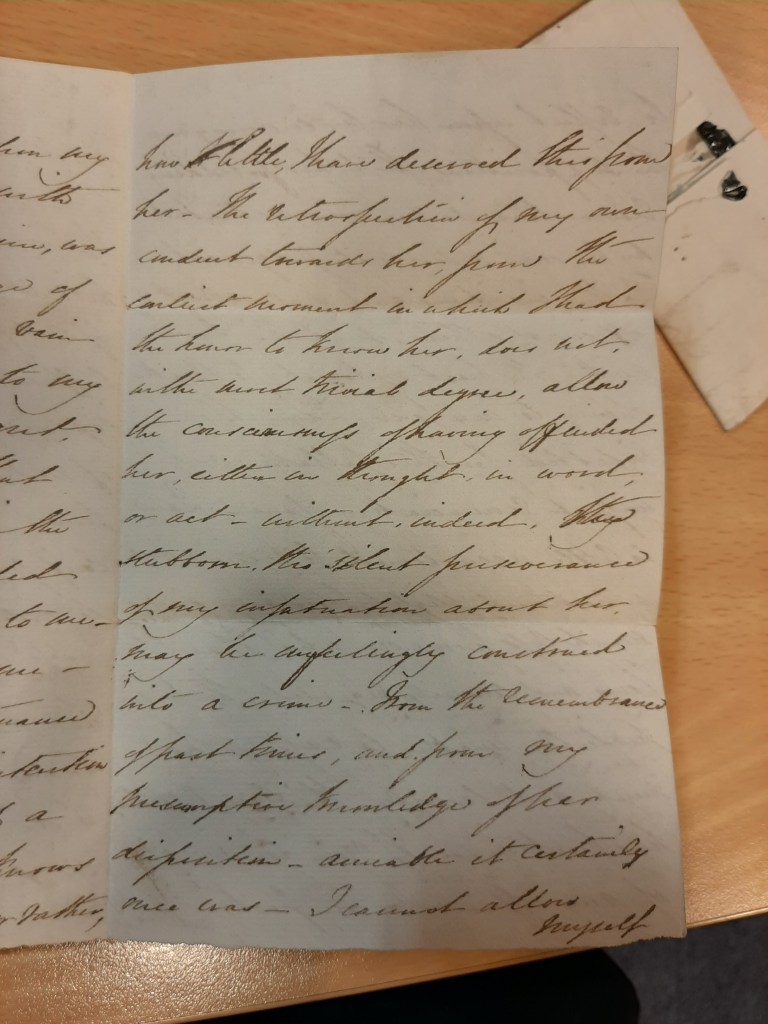
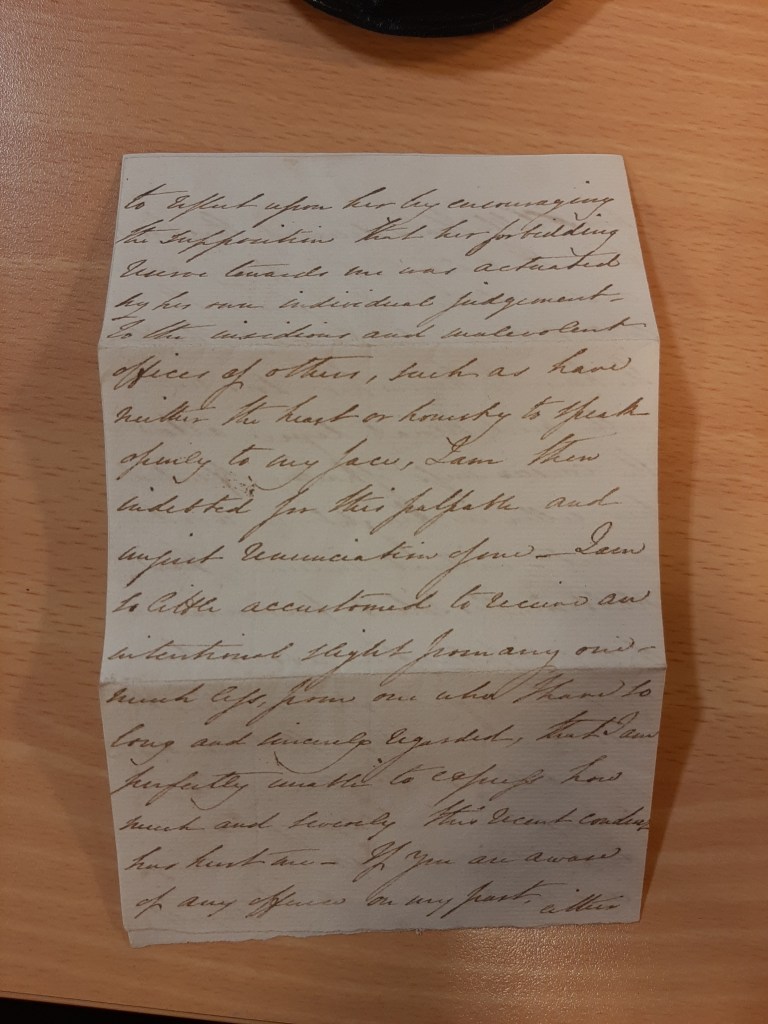
Heaven only knows how, or rather how little, I have deserved this from her. The retrospection of my own conduct towards her, from the conduct moment in which I had the favour to know her, does not, with much trivial degree, allow the consciousness of having offended her, either in thought, in word, or act – without indeed my stubborn, the silent perseverance of my infatuation about her, may be unfeelingly construed into a crime – from the remembrance of past times, and from my presumptive knowledge of her disposition – amiable it certainly once was – I cannot allow myself to reflect upon her by encouraging the supposition that her for bidding reserve towards me was actuated by her own individual judgement.
To the insidious and malevolent offices of others, such as have neither the heart or honesty to speak openly to my face, I am then indebted for this palpable and unjust renunciation of me – I am so little accustomed to receive an intentional slight from anyone – much less, from one who I have so long and sincerely regarded, that I am perfectly unable to express how much and severely this recent conduct has hurt me. If you are aware of any offence on my part, either…[letter ends]
George Brummell to Lady Monson, ‘Friday’
[first page missing]
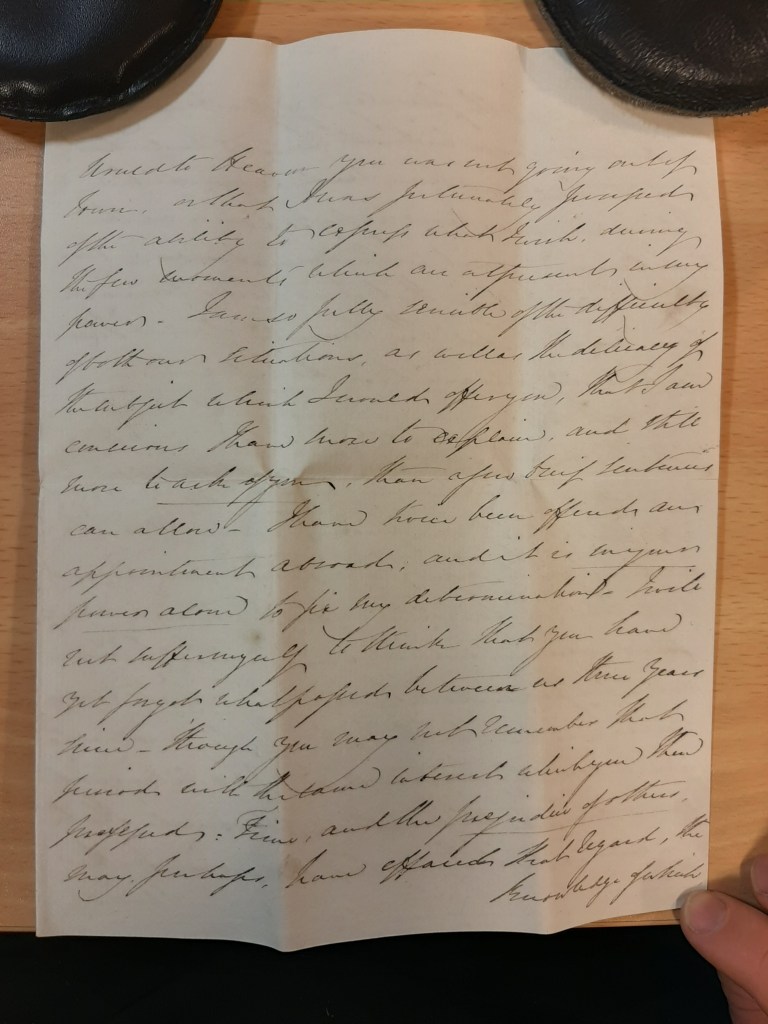
would to heaven you was not going out of town, or that I was particularly possessed of the ability to express what I wish, during the few moments which are at present in my power.
I am so fully sensible of the difficulty of both our situations, as well as the delicacy of the subject which I would offer you, that I am conscious I have more to explain and still more to ask of you, than a few brief sentences can allow. I have never been offered an appointment abroad, and it is in your power alone to give my determination, […] yet suffering as to think that you have yet forgot what passed between us three years since – thought you may not remember that period with the same interest which you then possessed: time, and the prejudice of others, may perhaps have effaced that regard, the knowledge of which
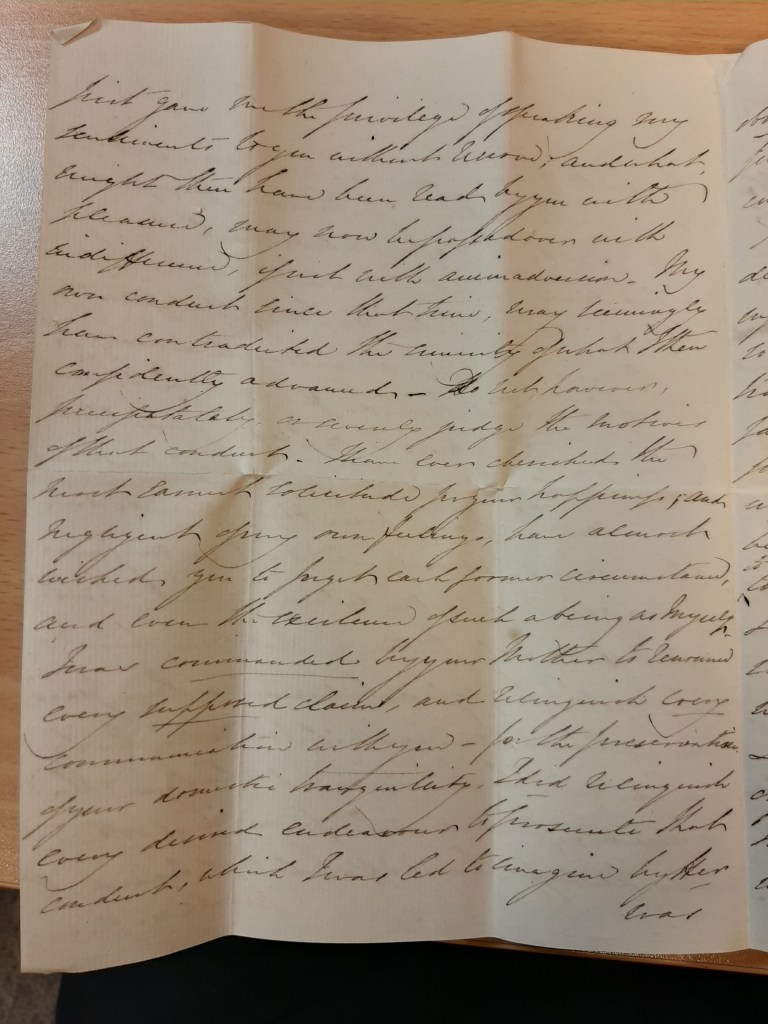
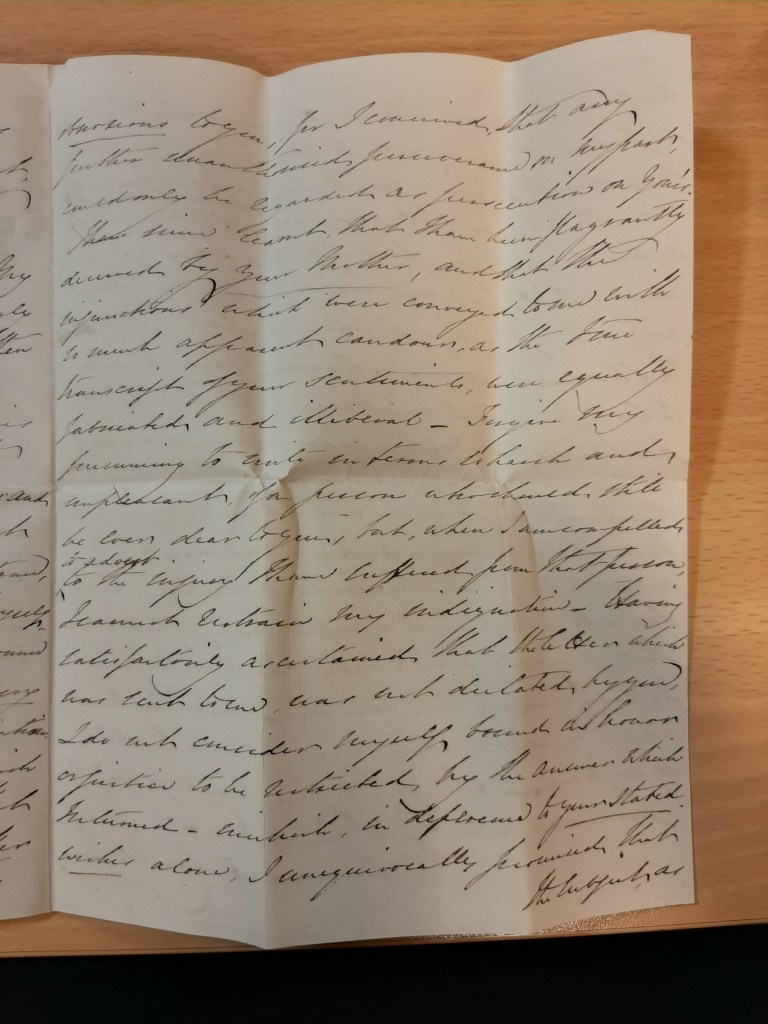
first gave me the privilege of speaking my sentiments to you without reserve, and what might then have been read by you with pleasure, may now be passed over with indifference, if not with animadversion. My own conduct since that time, may seemingly have contradicted the amity of what I then confidently advanced, to not have even precipitately or evenly judge the motives of that conduct, I have ever cherished the most earnest solicitude for your happiness and negligent of my own feelings, have almost wished you to forget each former circumstance and even the existence of such a being as myself, I was commanded by your mother to end every supposed claim and relinquish every communication with you, for the preservation of your domestic tranquillity. I did relinquish every desired endeavour to prosecute that conduct, which I was led to imagine by her was obnoxious to you, for I conceived that any further […] perseverance on my part could only be regarded as persecution on yours.
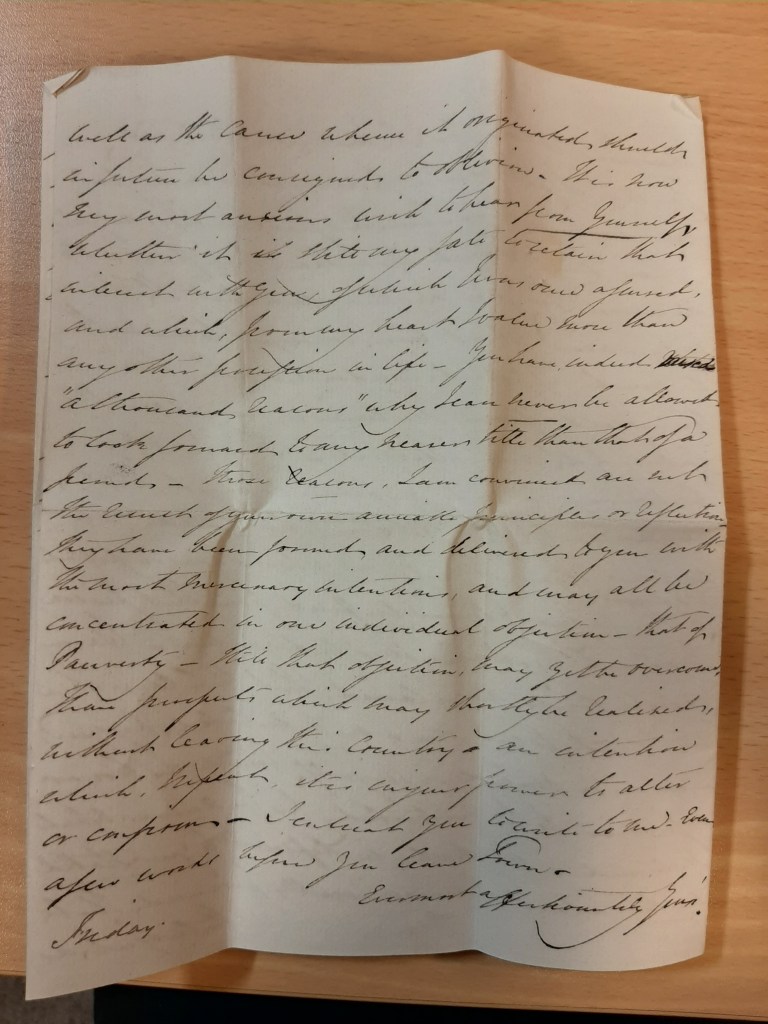
I have since learned that I have been flagrantly deceived by your mother, and that the injunctions which were conveyed to me with so much apparent candour, as the fine transcript of your sentiments, were equally fabricated and illiberal – forgive my presuming to write in terms so harsh and unpleasant of a person who should still be ever dear to you, but, when I am compelled to adopt to the injury I have suffered from that person, I cannot as restrain my indignation. Having satisfactorily ascertained that the letter, which was last to me, was not dictated by you, I do not consider myself, bound as honour or justice to be restricted by the answer which returned, methinks in deference to your stated wishes alone, I unequivocally perceived that the subject as well as the cause when it originated should in future be consigned to oblivion, it is now my most anxious wish to hear from yourself whether it is still my fate to retain that interest with you, of which I was once assured, and which, from my heart I value more than any other perfection in life – you have, indeed, “a thousand reasons” why I can never be allowed to look forward to any nearer title than that of a friend – those reasons, I am convinced are not the result of your own amiable principle or reflection, they have been formed and delivered to you with the most mercenary intentions, and may all be concentrated in one individual objection – that of poverty – still that objection may yet be overcome, those prospects may shortly be realised, without leaving this country, an intention which I repeat, it is in your power to altar or confirm – I entreat you to write to me, even a few words before you leave town.
George Brummell to Lady Foley, ‘Wednesday’
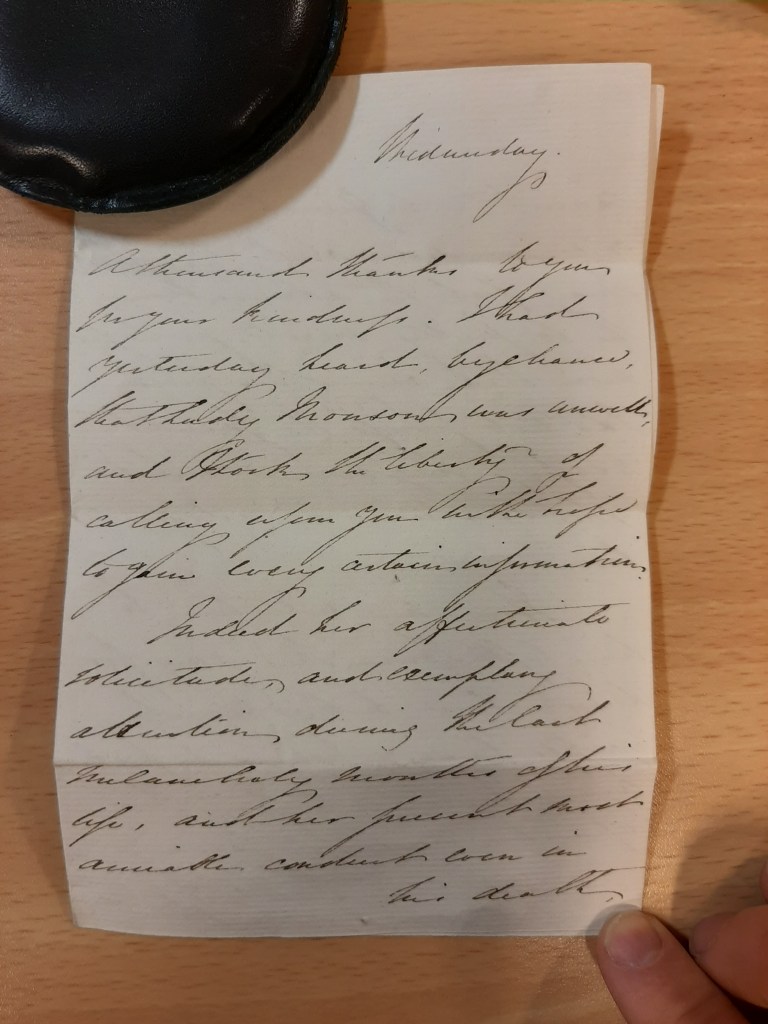
A thousand thanks to you for your kindness. I had yesterday heard by chance that lady Monson was unwell and I took the liberty of calling upon you in the hope to gain every certain information.
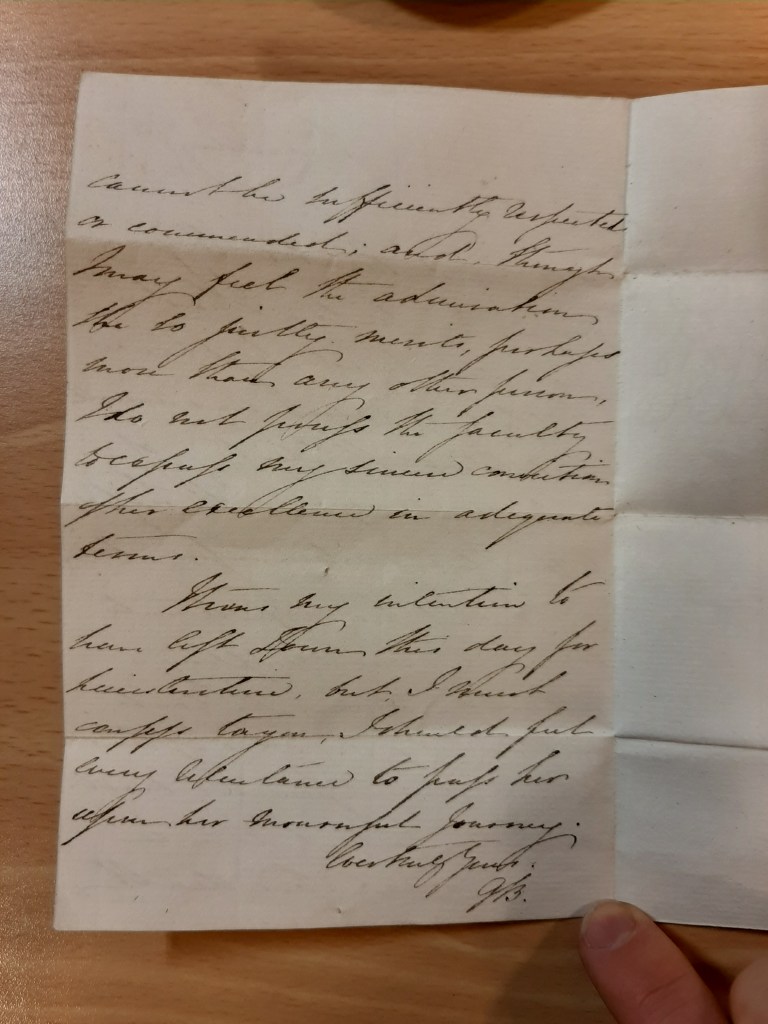
Indeed her affectionate solitude and exemplary attention during the last melancholy months of this life, and her present most amiable conduct even in this death cannot be sufficiently respected or commended, and, though I may feel the admiration she so justly merits, perhaps more than any other person, I do not possess the faculty to express my sincere conviction of her excellence in adequate terms.
I have my intention to have left town this day for [?], but I must confess to you, I should put every repentance to pass her upon her mournful journey.
George Brummell to Lady Sarah Savile, ‘Sunday night’
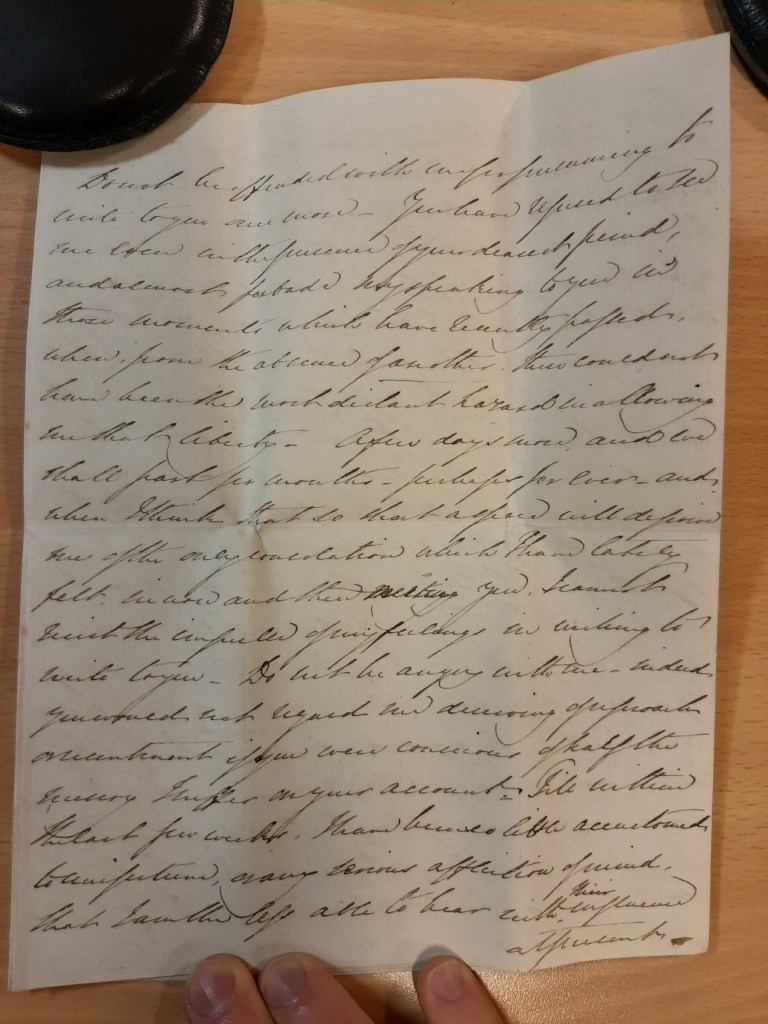
Do not be offended with me for presuming to write to you once more – you have refused to see me even in the presence of your dearest friend, and almost forbade my speaking to you in those moments, which have recently passed, when, from the absence of another, there could not have been the most distant hazard allowing me that liberty. A few days more, and we shall part for months – perhaps for ever, and, when I think that so short a space will deprive me of the only consolation which I have lately felt inured and then meeting you.
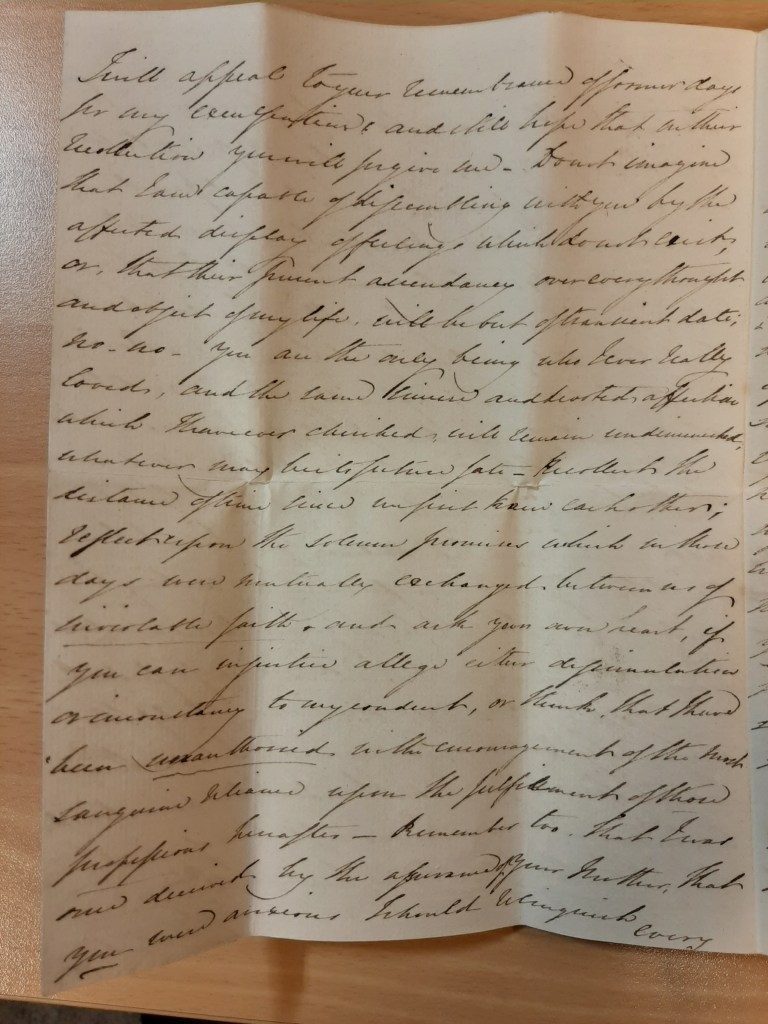
I cannot resist the impulse of my feelings in wishing to write to you – do not be angry with me, indeed you would not regard me demurring of reproach or resentment if you were conscious of half the misery I suffer on your account. Still within the last few weeks, I have become little accustomed to any future, or any desirous affliction of mind, that I am the less able to hear with their influence I will appeal to your remembrance of former days for my explanation and will hope that with their resolution you will forgive me.
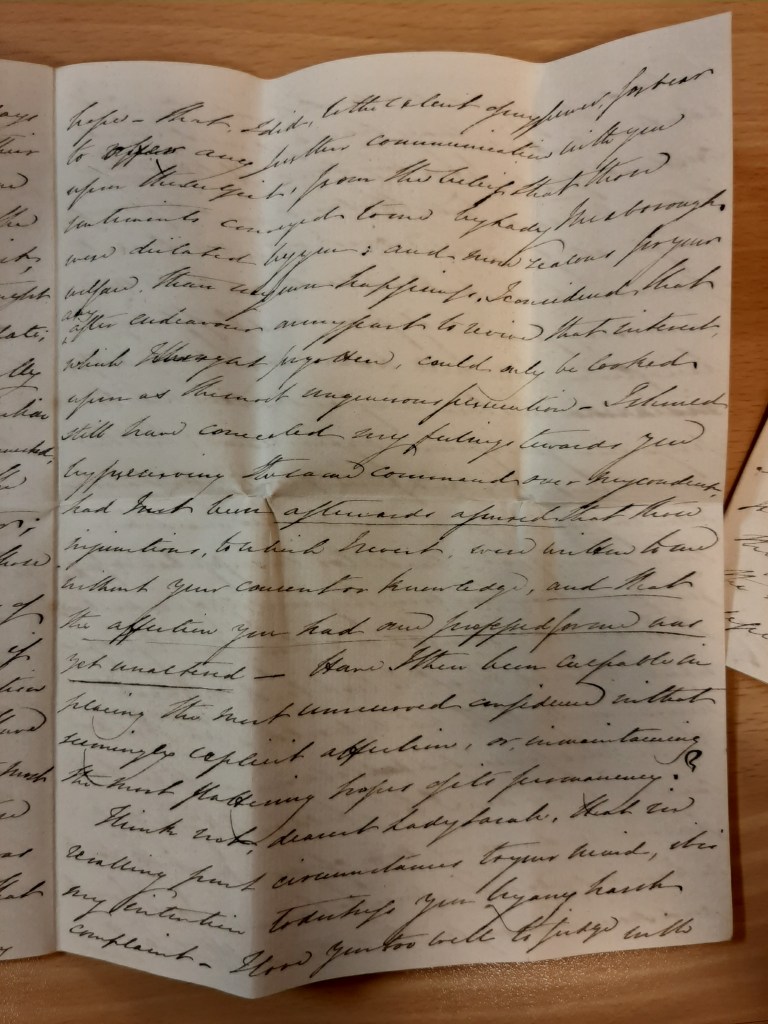
Do not imagine that I am capable of displeasing with you by the affected display of feelings which do not exist, or, that their present ascendancy over every thought and object of my life, will be but of transient date; no, no – you are the only being who I ever really loved, and the same sincere and devoted affection which I have ever cherished, will remain undiminished, whatever may be its future fate – recollect the distance of time since we first knew each other; reflect upon the solemn promises which in those days were mutually exchanged, between us of irresistible faith, and ask your own heart, if you can in justice allege either difinutation or inconstancy to my conduct, or think, that I have been unauthorised with encouragement of the most sanguine reliance upon the fulfilment of those professions hereafter – remember too, that I was near deceived by the assurance of your mother, that you were anxious I should relinquish every hope – that I did, to the extent of my power, forbear to offer any further communication with you upon [?] from the belief that those sentiments conveyed to me by lady Mexborough were dictated by you, and more zealous for your welfare than my own happiness I concluded that any after endeavour on my party to revive that interest, which I have yet begotten could only be looked upon as the most ungenerous persecution, I should still have connected my feelings towards you by preserving the command over my [?] had not been afterwards assured that there injunctions, to which [?] and written to and without your consent or knowledge, and that the affection you had and possessed for me was yet unaltered – have I then been capable in placing the most unreserved confidence without seemingly complicit affection, or, in maintaining the most flattering papers of its permanency?
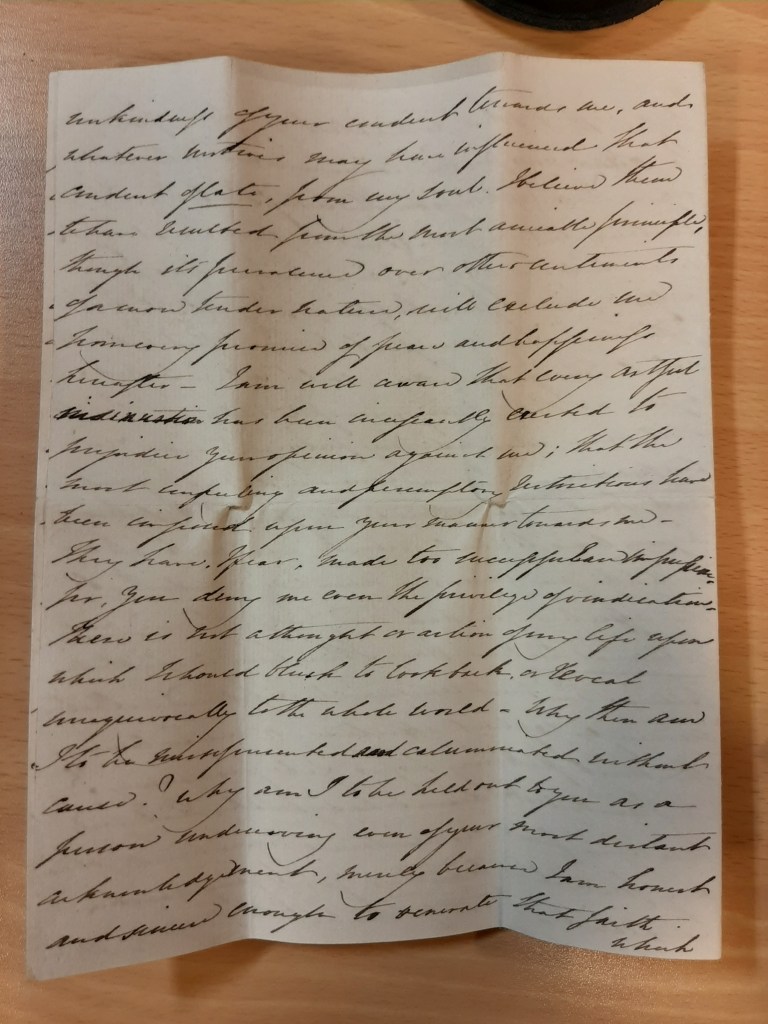
Think not dearest lady Sarah that in recalling past circumstance to your mind, it is my intention to distress you by my harsh complaints, I love you too well to judge with unkindness of your conduct towards me, and whatever motives may have influenced that conduct of late, from my soul I believe them to have resulted from the most amiable principle, though its prevalence over other sentiments of a more tender nature, will exclude me from every promise of peace and happiness hereafter – I am well aware that every artful insinuation has been inaccessibly evicted to prejudice your opinion against me, that the most compelling and preceptory intentions have been injured upon your manner towards me – they have, I fear made too successful in possession, for you deny me even the privilege of indication there is not a thought or action of my life upon which I should blush to look back or reveal unequivocally to the whole world. Why then am I to be misrepresented and calumniated without cause?
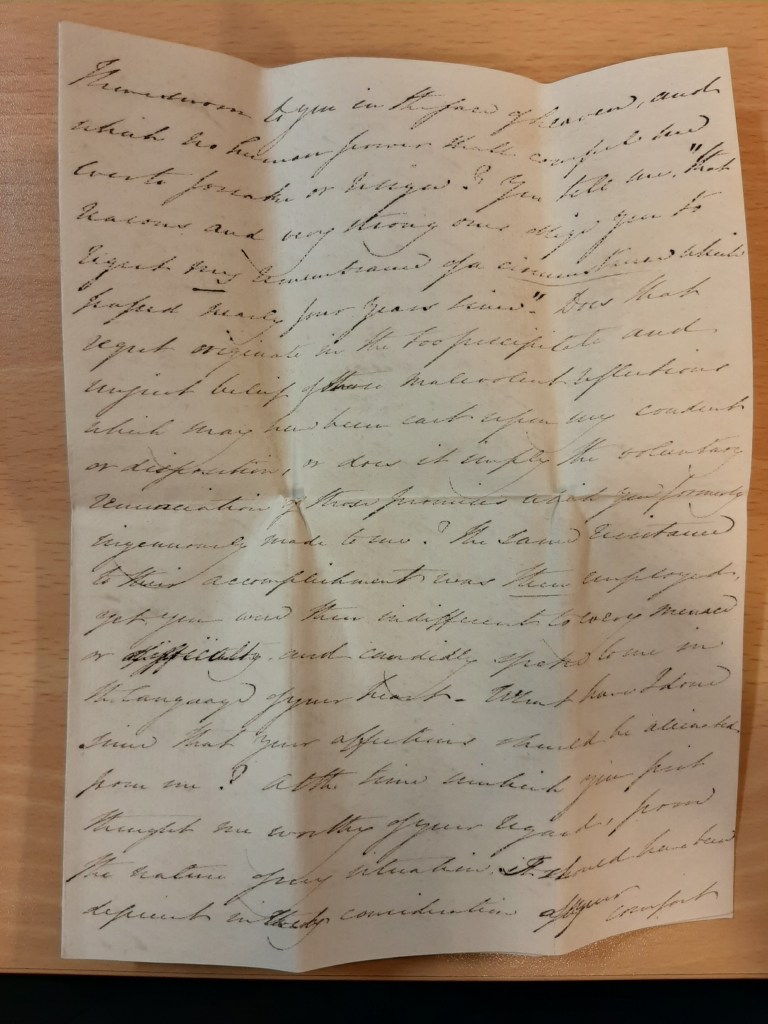
Why am I to be held to you as a person undeserving even of your most distant acknowledgement, merely because I am honest and sincere enough to return that faith which I have given to you in the face of heaven, and which no human power shall compel me ever to forsake or vilify? You tell me “that reasons and very strong ones oblige you to regret my remembrance of a circumstance which passed nearly four years since.” Does that regret originate in the too precipitate and unjust belief of those malevolent reflections which may have been cast upon my conduct or desperations, or does it imply the voluntary renunciation made to me now? The same existence to this accomplishment was then employed yet you was then indifferent to every measure or difficulty and candidly spoke to me in the language of your heart. What have I done since that your affections should be alienated from me? At the time [?] your past thought me worthy of your regards, from the return of my intention.
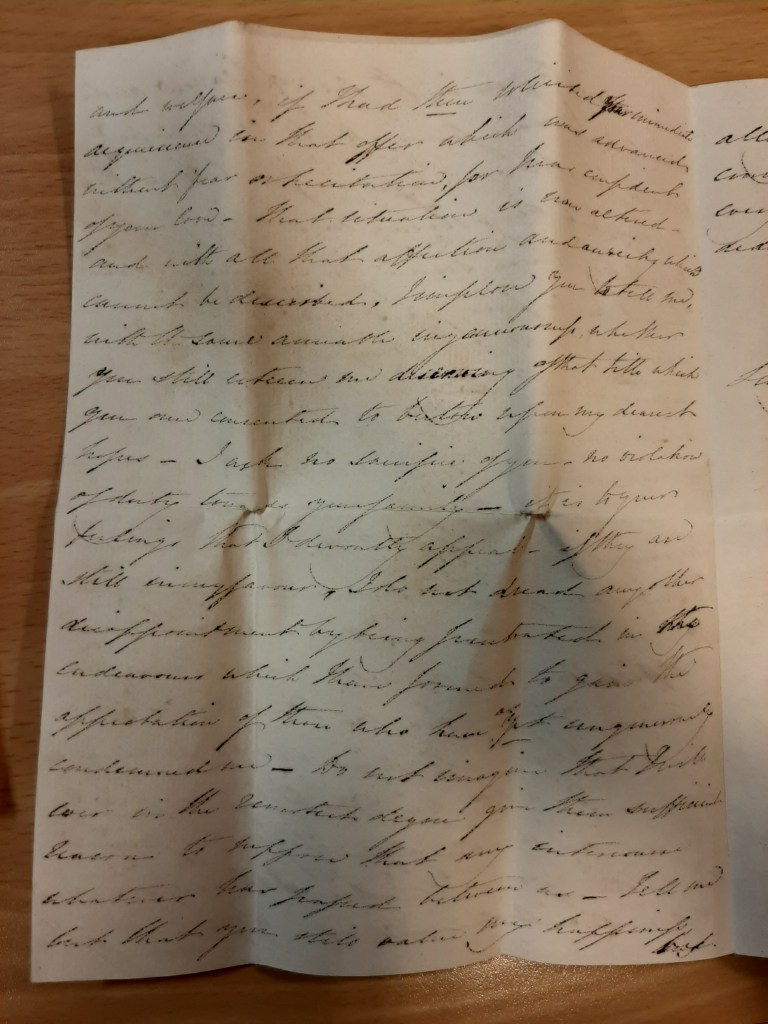
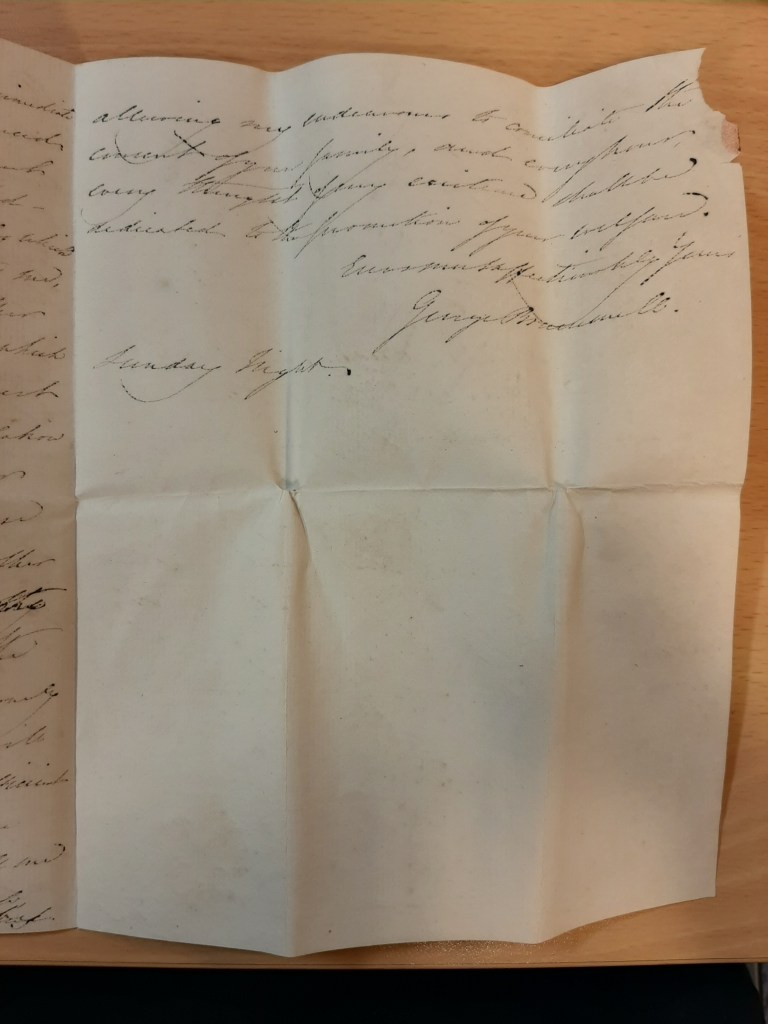
I should have been disquiet in my communication at your comfort and welfare, if I had then solicited your immediate acquiescence in that offer which was advanced without fear or hesitation, for I was confident of your love. That situation is now altered, and with all that affection and anxiety which cannot be described, I implore you to tell me, with the same amiable [?] whether you still esteem me deserving of that title which you once consented to bestow upon my dearest hopes – I ask no sacrifice of you, no violation of duty towards your family – it is to your feelings that I devoutly apply. If they are still in my favour, I do not dread any other disappointment by being frustrated in the endeavour which I have formed to gain the appreciation of those who have as yet ungenerously condemned me. Do not imagine that I will ever in the seventh degree five them sufficient reason to suppose that any intercourse whatever has passed between us – tell me but that you still value my happiness too allowing my endeavours to conciliate the consent of your family, and every hour every thought of my existence shall be dedicated to the promotion of your welfare.
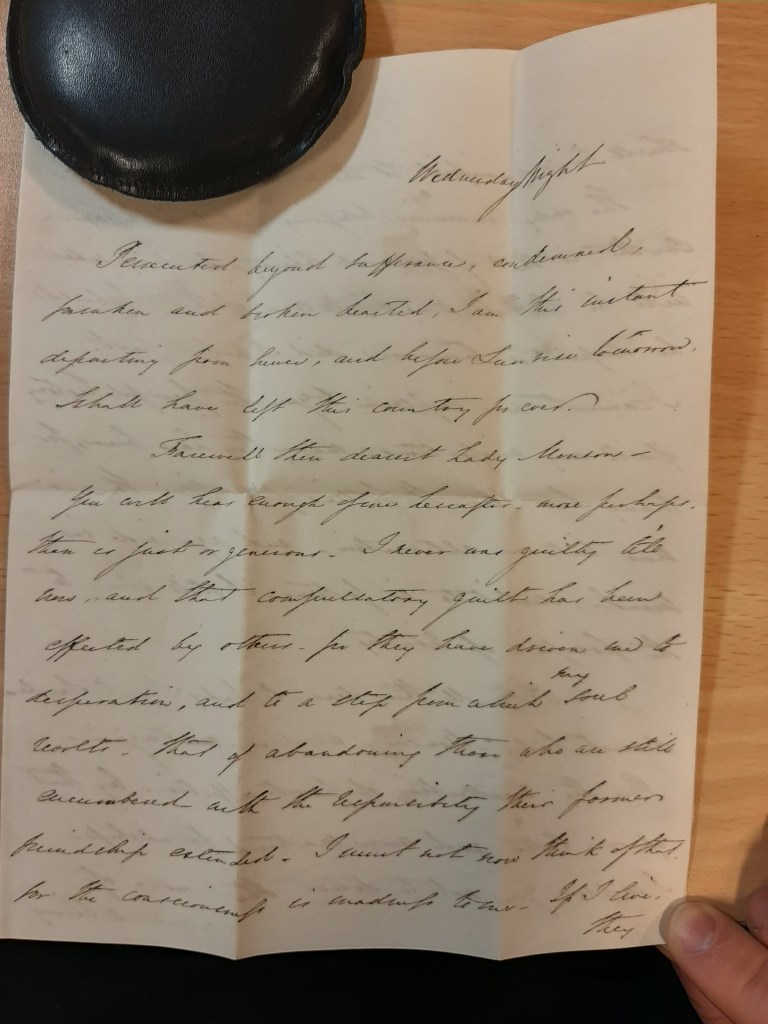
George Brummell to Lady Monson, ‘Wednesday night’
Persecuted beyond sufferance, condemned, forsaken and broken hearted, I am this instant departing from Dover, and before sunrise tomorrow I shall have left this country for ever.
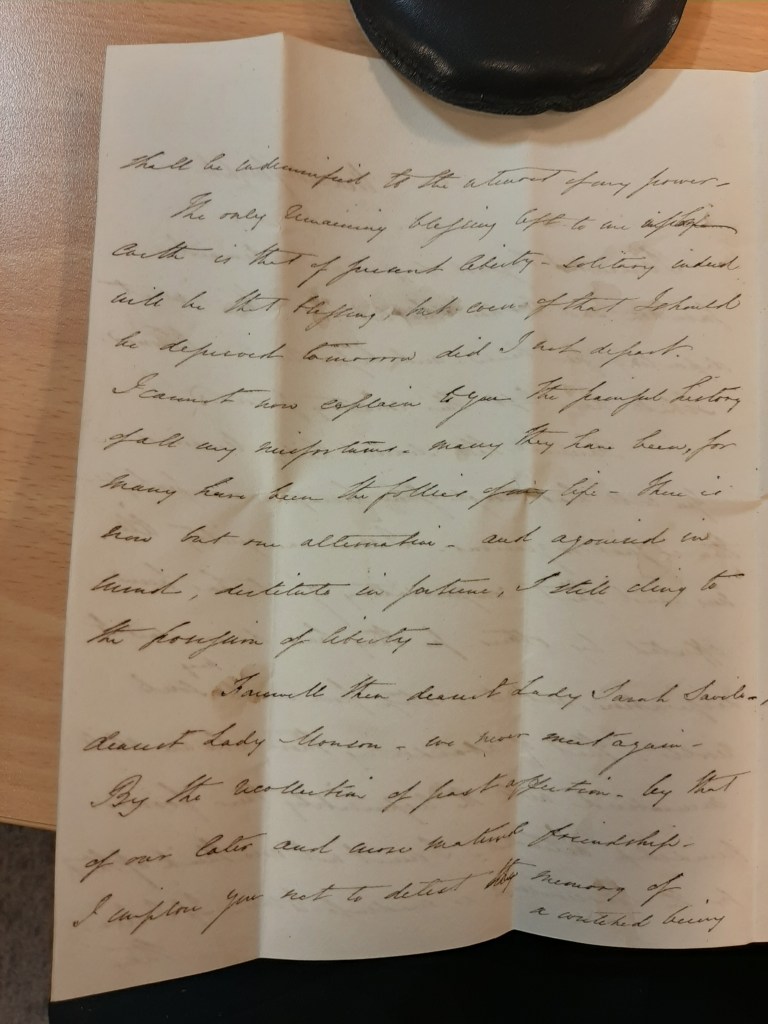
Farewell then dearest Lady Monson – you will hear enough of me hereafter, more perhaps than is just or generous. I never was guilty till now, and that compensatory guilt has been effected by others, for they have driven me to desperation, and to a step from which my soul revolts. That of abandoning those who are still encumbered with the responsibility their former kindship extended. I must not now think of that for the coerciveness is madness to me. If I live they shall be to the interest of my power.
The only remaining blessing left to me on this earth is that of fervent liberty, solitary indeed will be that blessing, but even of that I should be deprived tomorrow did I not depart.
I cannot now explain to you the painful history of all my misfortunes. Many they have been, for many have been the follies of my life – there is now but one alternative, and agonised in mind, destitute in fortune, I still cling to the possession of liberty.
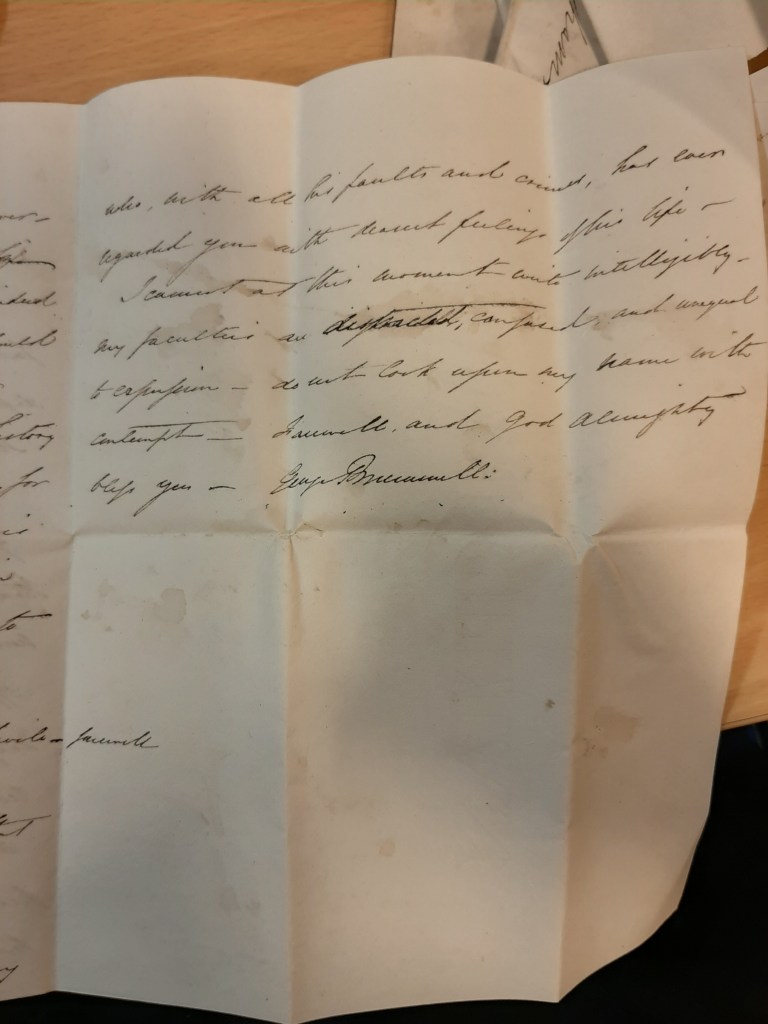
Farewell then dearest lady Sarah Savile, dearest Lady Monson, we never meet again. By the recollection of past affection, by that of our later and more mature friendship – I implore you not to detest this memory of a wretched being who, with all his faults and crimes, has ever regarded you with dearest feeling of this life – I cannot at this moment write intelligibly, my faculties are displaced, confused, and unequal to expression – do not look upon my name with contempt, I am well and God almighty bless you.
 The Warwick Historian
Leave a comment